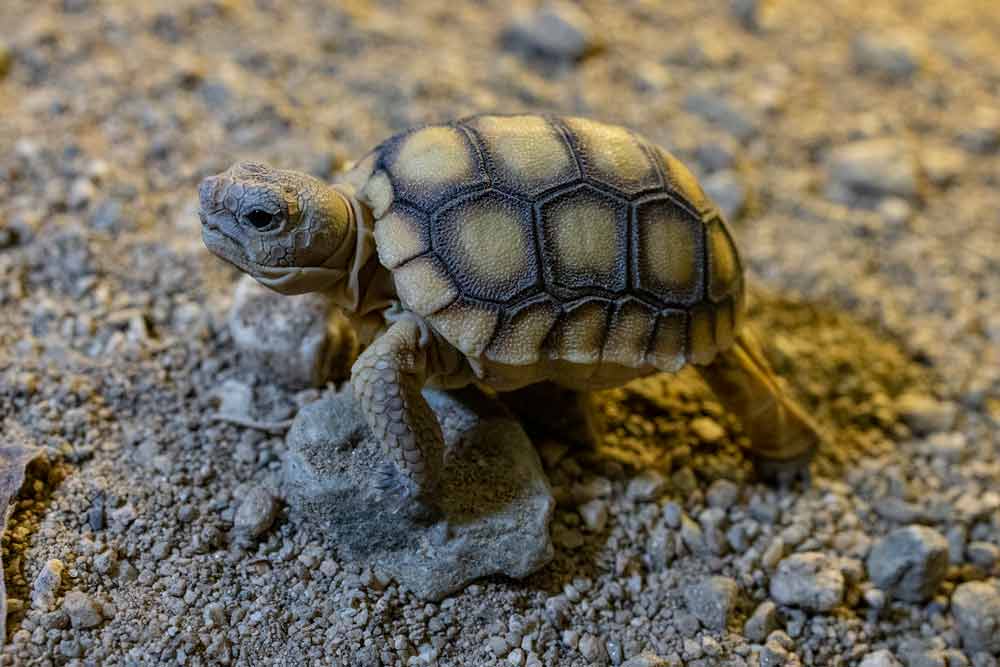
The San Diego Zoo Wildlife Alliance and The Living Desert Zoo and Gardens announced on April 15 that 70 critically endangered Mojave desert tortoises (Gopherus agassizii), part of a headstart program, have successfully emerged from their winter burrows on Edwards Air Force Base in Southern California.
In collaboration with Edwards Air Force Base, the U.S. Fish and Wildlife Service, and the U.S. Geological Survey, the alliance employed headstart techniques designed to enhance the tortoises’ survival in the wild. This process involved one to two years of indoor captive care at The Living Desert, allowing the tortoises to grow three to five times their original size, which helps them ward off predation. After this care period, they were released into their native habitat on the base. Melissa Merrick, Ph.D., associate director of recovery ecology at San Diego Zoo Wildlife Alliance, stated, “We’ve worked so hard to get here, and we’ve been through so much together. We’ve had to re-strategize, switch plans, react and adapt to so many emerging situations, and we’ve all done it successfully to get to this point. The second group of young headstart tortoises just arrived from The Living Desert and will spend the next six months with us before joining their predecessors in the wild. It’s an exciting time for the program.” The program faced significant challenges. Over a year ago, a heat wave necessitated an emergency egg excavation to prevent likely fatalities. The Living Desert staff cared for the tortoises a month early and during various hatching stages. A second emergency excavation occurred in September 2023 when predatory ants and fly larvae attacked the eggs and hatchlings. It is speculated that Hurricane Hilary’s wet conditions in Southern California enabled these insects to proliferate rapidly. James Danoff-Burg, Ph.D., director of conservation at The Living Desert Zoo and Gardens, emphasized, “Our headstarting program is essential for maximizing the success of young tortoises as we release them into the wild. Mortality of juvenile desert tortoises is dramatic, often approaching 100% in areas where ravens are overpopulated due to humans providing them food via open trash containers.” Related headlines include: – California’s Desert Tortoise Populations To Be Strengthened By Military Head Start Program – US Marines Control Raven Populations To Save California Desert Tortoises – California Desert Tortoise Granted Temporary Endangered Species Status A video is available: https://reptilesmagazine.com/wp-content/uploads/2024/04/Desert-Tortoise-Reintroduction-B-Roll_1.mp4 A photo shows a desert tortoise being released at Edwards Air Force Base (Photo by Ken Bohn, Staff Photographer, 2022 © San Diego Zoo Wildlife Alliance).The benefits of headstarting are clear. In only six months, we can get tortoises to the approximate size of a two-and-a-half-year-old! Larger tortoises are much more resistant to raven and coyote predation than smaller ones. Our headstarting program ensures that not only are normal juvenile mortality rates in the wild reduced, but predation is also decreased. This makes reintroductions of desert tortoises more successful.
About the Desert Tortoise: The California desert tortoise was granted temporary endangered species status by the California Fish and Game Commission in October of 2020. Its range includes the Mojave and Sonoran deserts in Southern California, and it can also be found in Arizona, Nevada, and areas in Mexico. It grows to about 8 to 10 lbs. and eats mostly weeds and leafy greens in the wild. The desert tortoise is a protected species, and it is speculated that more desert tortoises can be found in captivity than in the wild.